Depending on which particular church you may be in, the first word of the Creed is either “I” or “We.” (and don’t worry, we’re not going to go through each word individually, just making a point on this one. Settle down.)
You may think it doesn’t matter. Who cares if it’s I or We?
Normally I would agree with you, and for most of Church history it probably didn’t matter. But, in my opinion, this has become an issue in recent years, particularly in the American Church, and so I wanted to draw a little bit of attention to it.
We, and by “we” I mean primarily the white American church, have incorporated (“syncretized” if you’re into that sort of book learnin’) individualism into our practical theology to such a degree that it now seems normal or the way it should be. American Christians arguably don’t know it’s not the universal experience of the Church. We have no idea how foreign this focus on self is to other societies or, I would argue, the Biblical church.
For many other cultures, the group you belong to is more important than you as an individual. I won’t get into the entire issue here, since lengthy books have been written on it, but consider two examples.
Example One: You are born in a poor village in India, and show intellectual promise as a child. The village needs a doctor, and so they come together to pay for you to attend medical school, and then you return to the village to live as the local doctor. But what if you don’t want to be a doctor? You want to be a musician or a plumber. For many people, that doesn’t matter. Your village needs a doctor, you have been gifted with the intellectual ability to fulfil that role, and so you are a doctor. You have a responsibility to people other than yourself. Your own personal dreams or desires come after the village needs.
Example Two: When two American men meet, they will usually start with an introduction, but the next question is almost always “and what do you do for a living, Bob?” The job you have, or your desired job perhaps, is part of your identity. Your choices and pursuits are center stage. In other cultures, when men meet (sorry, I don’t know what happens when women meet, since I’m not one), after the introduction, the first question is often “and where is your family from?” or “and who was your father?” For us in America, these seem like completely unrelated issues, but in those cultures (and just to be clear, this is the rule for cultures throughout history/world; America is the odd one out) the group or family or nationality is more important than who you as individual are. You are part of a whole, not a solitary being.
This is the way the Church has been in most times/places; we are part of a whole. Belonging to the church, serving the body, was more important that finding what I want. And the Creeds reflected this.
BAPTISM AND THE CREEDS
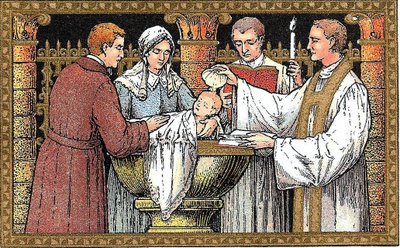
For many churches the rite of baptism is when one publicly commits their life to Christ (or a sponsor commits the person to Christ, in the case of infant baptism). Often the Apostle’s Creed is recited and phrased in the form of a question-response:
“Do you believe in God the Father, Creator of heaven and earth?”
“Yes, I believe.”
So, thus far it is an individual experience: do you believe….I believe.
However, then the person being baptized concludes with “This is our faith. This is the faith of the Church. We are proud to profess it, in Christ Jesus our Lord.” Our faith, faith of the church, we are proud…
When you become part of the Church, you do not belong to yourself anymore. You are part of the body of Christ, and one of our goals as believers is to give up our rights to ourselves in service to others. I serve my fellow believers, I prefer others above myself, I turn the other cheek, I do to do others what I would like them to do to me. I give up what is good for me in the pursuit of what is good for you.
It goes against our experience as Americans. We want to be in control of our lives. We tell ourselves we aren’t responsible to anyone but ourselves. We want to follow our dreams. If a church isn’t making us feel fulfilled, we go find a new one. We have the right to be happy after all.
But the truth is, when we affirm the Apostle’s Creed, we are willingly and knowingly giving up some of our rights to our individuality in order to better serve the Body. We are no longer in charge of our lives; we are fully submitted (or we work and train ourselves to submit) to the headship of Jesus, and part of that submission is serving his Church, His Bride.
GIVING UP IS HARD TO DO
I get it. Trusting others in the church is not all that appealing. We are afraid of abuse in the Church (or perhaps have even experienced it). We are afraid that we will be taken advantage of or hurt. We all know the stories of power-crazy pastors, or manipulative counseling sessions, or someone in leadership suppressing our gifts and calling. I’m not saying it’s easy. It’s often downright painful at a soul-crushing level.
We want to have control, and to protect ourselves, and to make sure that those who take advantage or us get what they deserve. But that’s not what we’re called to do. This is the faith of our church. This is our body. This is our family. We choose to become part of the we, not because we trust the people in the church, but because we trust the Head of the church.
But do you believe the creed? Do you believe it’s God’s will for the “I” to become “we”? Can you trust that the you you will become when you accept a place within the church will be the youest you that you could be? (yeah, I know that sentence is confusing to read. It was confusing to write, too.)
The Creed starts with a reminder that it is no longer I that lives; but Christ is living in me. I am not my own any longer; I am fully and completely His. And he loves his Church, with a fiery, self-sacrificing love. If I am to become one with Christ, I also must become One with his church. We trust that by giving ourselves to others in our holy communion with Christ, we are both fully integrated and fully ourselves.
Can we do it? Can we give up ourselves for others? Does our belief go that far?
With Christ’s help, we believe we can.