Ok, this is going to be a personal post (and loooong), and the reason I’m sharing it is because I think a lot of other people are going through the same mental process, and I’m going to be risky and put it online, hopefully to encourage them. I’m sure others will disagree, and they’re free to comment too and maybe we can find some common ground. (and I’ll try to put some pictures in to break it up a little.)
I had someone recently tell me that “many people” were wondering what’s happened to me. They say I’ve lost my footing as a Christian, how I’ve gone “woke” and “liberal.” Due to my crippling self-doubt, I’ve been pondering (i.e. obsessing over) that, wondering if it’s true. Am I missing something? Am I falling away from the faith? Why do I feel like more and more of an outlier in my church family?
Obviously, I think I’m relatively stable (-ish) and everyone else is changing, but how could I tell? Einstein’s relativity tells me I might not be able to tell, as everything would appear to be moving away from me if I was the one moving. (no, that’s not what Einstein said. I’m kidding.) I was sharing it with my family, and one of my sons asked, “how do you know if you’ve moved or they’ve moved?”
I thought that was a good question, and I’ve been trying to find ways of delineating it. So, I thought I’d do it publicly, ‘cause…you know…I like public floggings.
SELF-ASSESSMENT
So, the first thing is if there are issues I already know I’ve become more “liberal” on. To that I say “Yes,” in particular I know I’ve changed my position on the death penalty (was mildly for, now strongly against). This was a gradual change, starting about 10-15 years ago. I’m not sure exactly, but I know I was questioning when I started teaching in 2011 and had fully decided a couple years later.
I also think I’ve changed my position on LGBTQ+ issues, but not because I’ve changed what I believed. I still wholeheartedly stand with a Biblical ethic that says marriage is for one man and one woman (imago dei and whatnot), but I do not believe it is a Christian’s job to push that on the culture. Thanks to some pastoral teaching about ten years ago, I’ve concluded that we are taught in the Bible that we are to apply different standards to those in the church and those outside, so it’s self-centered of me to expect a culture that is intentionally non-Christian to follow Christian ideals.
For most other issues that divide liberals and conservatives, I’ve usually been pretty ambivalent. I didn’t follow politics that much before 2015, and generally followed the idea that “good” Christians were conservative and voted Republican. I grew up thinking Reagan was The Man and George H.W. was a decent guy that hit a bad economy. I voted for Dole because Bill Clinton was so immoral, voted for Bush W. twice mildly enthusiastically, and (I think) McCain, because he was a moderate conservative.
UMM…I HAVE QUESTIONS

But then came Romney, and I started hesitating more. I knew I grew up hearing how Mormons weren’t “really” Christians, and I had done enough reading on their beliefs to think maybe I couldn’t in good conscience support him. But what really caught me off guard was the growing talk of “you as a Christian MUST vote for Romney to stop that liberal Obama.” To me, sure Obama was liberal (he never made a secret out of that), but since when was my vote tied to my faith in Jesus?
I was an historian enough by that point to know that the parties had switched platforms (in large ways and small) on occasion, so I didn’t see my Christian identity tied exclusively to one of them. If one happened to be more Christian in a particular election, so be it. Many of the God-fearing Christian farmers/saints across my rural state had voted Democrat for years/decades, so I didn’t think I should be challenging their salvation over it. If we were just voting for the “most” Christian candidate, the universalist Obama didn’t seem all that different from the Mormon Romney.
Then came 2016, and I saw Trump gathering momentum. I told my class at the time “there’s no way he’s going to get nominated, because the GOP knows even if he happens to be the most popular in the primary, Christians will never support someone who so obviously doesn’t care about Christian principles. And the GOP depends on the conservative Christian vote, so they have to at least consider their opinion.”
And I was wrong.
So I told my students “That was so dumb of the Republicans. Now they basically handed the election to Clinton, because the Christians I know and listen to have said for years that the character and morality of a leader matters, and they’ll never vote for Trump.”
And I was wrong. Again.
GOING LIBERAL…I GUESS
And suddenly I was branded a liberal for my stances. And what are those stances?
Character in leaders matters.
We should put helping the poor above lower taxes for the wealthy.
We should care more about helping immigrants than our national borders.
We should do what we can to help the sick, including medical care.
These are not positions I think of as particularly “liberal,” and certainly not positions that I’ve changed much on since I was young. I don’t think I’ve shifted “left” on any them, though of course I could be wrong and just not remembering.
I am 100% a believer in the literal and historical truth of the Bible; I think we should filter all of our life through the lens of Scripture. I do not believe we separate who we are on Sunday from who we are the rest of the week, or in the voting booth. That does NOT mean that one particular candidate or party automatically gets my vote.
And I think (at least I think I think) that way because that’s what I was taught when I was growing up, because of the people who said “you should vote along Christian lines.” And I believed them. I was taught “you should vote for leaders with character, for the good of the nation,” and I believed them. “You should do what you can (including vote) to help the least of these,” and I believed them.
If I may be more blunt, I did not realize that their unspoken ending was “as long as they have an (R) after their name.” I didn’t realize “my rights” was more important that “your poverty.” I didn’t realize that when we were told to help the foreigner by supporting missionaries, that didn’t include letting them into our neighborhoods.
THE BIG ISSUE…MAYBE
The big issue that everyone brings up is abortion. You have to vote Republican if you are pro-life, right? Ok, let’s talk about that one. So, quick rundown as I’ve talked about his extensively elsewhere:
1 – I am 100% life-starts-at-conception prolife, and I think our family story reflects that, but I am also 100% we-need-to-help-women prolife.
2 – I do not buy the argument that getting conservatives on the Supreme Court automatically overturns Roe V Wade, and even if it did, Roe V Wade is ridiculously over-emphasized in abortion issues. It is certainly not worth sacrificing every other stance for.
3 – Changing the law will do very little to stop abortions. It’s fine, but what if we focused on preventing the causes of abortion, rather than punishing women? Chief among those causes are poverty and financial hardship. Let’s work on those.
All that said, and this is my controversial take, I do not think abortion is as important to the people in the church as they claim. Ask adamant GOP evangelical people if they would have voted for Biden or Obama or Clinton if they had been pro-life. Is it about abortion or something else?
The stats indicate this as well. When I was growing up in the 80s and 90s, the big issues (allegedly) were abortion and gay marriage (and the Equal Rights amendment, but let’s hit that another time). Abortion has been a major issue for me my whole life. Still is.
But I’ve come to realize that abortion was intentionally just a political carrot for Christians, in order to secure votes for a GOP that was primarily about rolling back civil rights legislation (I’ll go into this more in a different post, but feel free to google Reagan and Bob Jones University).
WHAT’S REALLY IMPORTANT
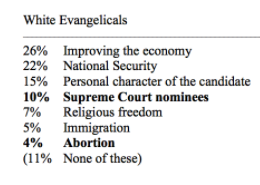
So if it’s not abortion, then what IS important to evangelical voters? In 2016, the major issues for evangelicals were (in order): Improving the economy, National Security, Personal character of candidate (?!), Supreme Court Nominees, Religious Freedom, Immigration, and Abortion. Yep, abortion was last on the list.
Another study asking if issues were important to evangelicals, the order is Terrorism, Economy, Immigration, Foreign Policy, Gun policy, Supreme Court, Health Care, Social Security, Trade, Education, Abortion, Treatment of minorities, Environment. Again, abortion near the bottom of the least, only slightly above caring for the outcasts.
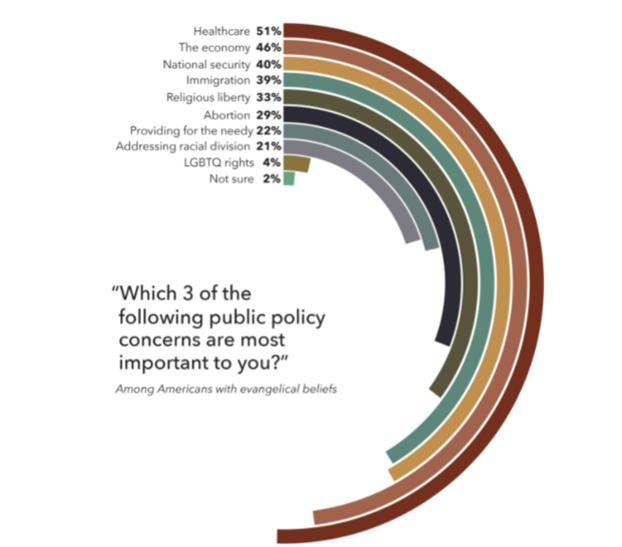
In 2020, it was Healthcare, the economy, national security, immigration, religious liberty, abortion, providing for the needy, racial division, and LGBTQ rights. Tighter borders, my freedom, my money, my health is more important than abortion or the needy?
Now here’s the kicker – 80% of evangelicals say “the Bible informs my political views.” (50% say strongly). But only 37% say “I have realized some of my political views were inconsistent with the Bible and needed to change.” (14% strongly).
In other words, they are saying “My views are so Biblical that I’ve never had to change them after studying the Bible.” Seems a little sketchy to me. If I’m just naturally right on everything and the Bible never corrects me, I’m going to go out on a limb and say that either my name is Jesus or I’m interpreting the Bible poorly.
My conclusion? The GOP and even some of the church never cared THAT much about abortion. Sure, it’s important, but not as important as being a conservative American. And I’m not down with that.
THROUGH A GLASS DARKLY
And so I found that my interpretation of “Christian” political activity did not line up with what many of fellow church goers thought. I found myself thinking: Which part of the Bible says to put national security ahead of the poor? Which part says keeping my rights to have church as I want are more important than welcoming the foreigner? And where in the world can you get that “my money” is more important than helping the poor?
I would say that these are things that I thought everyone in my church circles agreed on. “Of course” we would give up some our wealth to help the poor. “Of course” we would support candidates with good character over those who promised money or safety. “Of course” we would take risks to help foreigners.
But I was wrong.
I did not realize there were other issues more important to people, and there were ways of seeing things they probably assumed I shared that were not accurate. We both believed people in our church shared our same view of policies and culture, but we didn’t. I’ve discussed before how I think fundamentalists and evangelicals worshipped together under one roof from the 80s-2015, but now we’re seeing our differences. The small cracks have become chasms.
(Quick note, want to know which camp you’re in? Ask yourself if you believe there’s a “culture war,” or that culture is trying to destroy you and your family values, and you must fight to protect them and/or redeem the culture. If you say “yes,” you’re probably fundamentalist.)
SEE ALL THE PEOPLE
The issue is if we can move forward. I have been very disheartened to find out so many of my friends, family, and respected spiritual leaders probably fall into the fundamentalist camp. To be clear, I do not think this means they aren’t saved, or that we can’t do ministry together, or anything like that. It just means we have a fundamentally different view of how Christians are to act towards the culture at large, and I’m not sure that the two groups will be able to be in the same churches anymore.
I tend to think we’ll have some denominations split, or individual churches will have more one focus or the other, but I think the unity (faux as it was) from the days of my youth are probably gone.
I had thought that maybe I was just crazy; that somehow I had lost my way. I do have a lot of self doubt and second guessing, and I really respect the people who were seeing things differently than I did. I had many days of asking myself “am I the crazy one here?”
But thankfully I saw virtually all the national Christian leaders I respect were having the same experience. If people like Russell Moore, Beth Moore, Phil Vischer, David Platt, Max Lucado, and Al Mohler are the “new liberals,” then I think the conservative movement is falling so far Right that soon everyone but hard libertarians will be labelled as communists. These are people who have spent their lives studying the Word and immersing themselves in a scriptural worldview. If I find myself with similar views as this crowd, I’m not discontent.
So What’s Happened to Me?
Nothing, other than I think I assumed things about others in the church that weren’t true. And to be clear, I’m sure they assumed things about me, and that’s why they think I’ve gone off the rails. It’s not that I’ve changed (that much), it’s that their image of me was not accurate, and as more information and issues come out, there’s a dissonance. I thought they were evangelical, they thought I was fundamentalist. We were both wrong.
WHAT NOW?
And so now we look to move on. Personally, I think the people who believe I’ve lost it will continue to see me as getting more and more liberal, because issues keep coming out that fundamentalists and evangelicals disagree on. Additionally, I feel media is pushing people in my circles harder to the Right all the time, and so there’s more attention on people that aren’t. So I don’t really see that changing.
I suspect we’ll have more denominations split on these grounds. The Southern Baptists are already seeing church splits and “groupings” of churches banding together, such as the Conservative Baptist Network. I think that’s coming for all the evangelical denominations. Sooner or later, leadership will have to decide if they’re fundamentalist or evangelical, and lose part of their congregations. I think pastors/leaders trying to hold to the “old” way of everyone under one roof are fighting a losing battle, and will end up losing both. I think we have to move forward with our new information, not try to roll back the clock and hope everything goes back to “normal.”
Finally, I want to be clear that I’m not saying my position is the only correct one, or that liberals or conservatives are more correct, or that evangelical or fundamentalist is more correct. What I’m saying is that certain denominations can disagree, and still believe each other is saved and can work on ministry together, but they may not be in the same church week to week. We worship separately, but we still can minister and serve the over-all mission of Christ together. Even Paul and Barnabus split up, after all. It happens.
So, let’s take an honest look at what we have in common, where we disagree, and how we can move forward. Whether I’ve grown more liberal or others have grown more conservative is not the main point. The main point is that the Left and Right hands are still part of the Body, and we need each other. Making everyone into a “right” hand is neither Biblical nor possible. Let’s join together where we can, and celebrate our diversity where we can’t.
Until we are all brought into the full and complete vision of Christ.